The Physics of Soap Bubbles
The universe’s fundamental forces, captured in one shimmering, short-lived sphere.
A Universe in a Soap Film
Blow a soap bubble and watch it drift. For a few seconds it hangs in the air, turning slowly, its skin swimming with colors that seem to pour across the surface and vanish. Then, without warning, it is gone — leaving a faint mist and the sense that you saw something you didn’t quite have time to understand.
What you saw was physics showing off. A soap bubble is one of the most ordinary objects in the world and one of the most quietly profound. In that fragile film, thinner than almost anything you will ever see, several of nature’s deepest principles are all working at once: the way light behaves as a wave, the way surfaces pull themselves taut, the way liquids flow and thin and finally fail. The bubble is a laboratory you can hold on the tip of a wand.
It is also, frankly, beautiful — beautiful enough that people have spent careers photographing nothing else. The mathematics underneath it has occupied physicists for generations, and some of the questions bubbles raise are still being answered in laboratories today. Let’s walk through what is actually happening inside that shimmering skin.
The Rainbow Shimmer
Visible light: ~400–700 nmThe Perfect Sphere
Surface tension: ~0.025 N/mThe Moment of Rupture
Rim speed: tens of m/s → ~100 m/sMinimal Surfaces
Young–Laplace: ΔP = γ(1/R₁ + 1/R₂)Gravity’s Rainbow
Film: ~10 nm (top) → ~1000 nm (base)The Marangoni Effect
Driven by surface-tension gradientsThe Anatomy of the Skin
The wall of a bubble is a sandwich. Soap molecules are two-faced: one end loves water, the other flees from it. So they line up into two facing layers — water-hating ends pointing out into the air on both sides, water-loving ends pointing inward — trapping a thin sheet of water between them. That trapped water is what drains, evaporates, and eventually runs out, and when it does, the structure collapses.
The numbers tell the story of just how delicate this is. A bubble’s skin is measured in nanometers — so thin that the wavelength of visible light is larger than the film itself, which is the very reason light can interfere across it.
| Property | Typical value | Why it matters |
|---|---|---|
| ~10–1000 nm | Film thickness | Thinner than visible light’s wavelength — enables interference colors |
| ~0.025 N/m | Surface tension | The inward pull that forces a sphere and stores rupture energy |
| ~400–700 nm | Visible wavelengths | The band of light whose reflections add and cancel |
| 120° / 109.47° | Plateau angles | The fixed angles at which films and edges meet in foam |
The Deeper Science
Plateau’s Laws
120° faces · 109.47° edgesThe Antibubble
Liquid inside, gas shell outsideMaking Bubbles Last
Lab bubbles: survived over a yearBubbles, by the Numbers
- The colors of a bubble quietly forecast its death: when a spreading black spot appears at the crown, the film there has thinned to almost nothing, and only moments remain.
- In deep cold, a bubble doesn’t just freeze solid — ice crystals bloom and race across its surface like frost ferns spreading over a windowpane, a favorite subject for photographers.
- Humpback whales blow bubble nets, swimming in spirals to exhale walls of bubbles that herd fish into a tight, trapped column.
- Because gravity is what drains and thins a film, bubbles behave very differently in orbit — which is exactly why they’re studied on the space station, where fluids misbehave in instructive ways.
Explore Further
Watch & See
Veritasium — bubble & thin-film physics
A clear visual walk through interference and why the colors move.
Play & Simulate
PhET — Wave Interference
Slide the controls and watch waves add and cancel, the heart of bubble color.
Read the Research
Taylor–Culick speed
The physics of how fast a soap film retracts when it tears.
“A soap bubble is the most beautiful thing, and the most delicate, in nature.”— a sentiment often attributed to Mark Twain, in the spirit of every physicist who has stopped to watch one
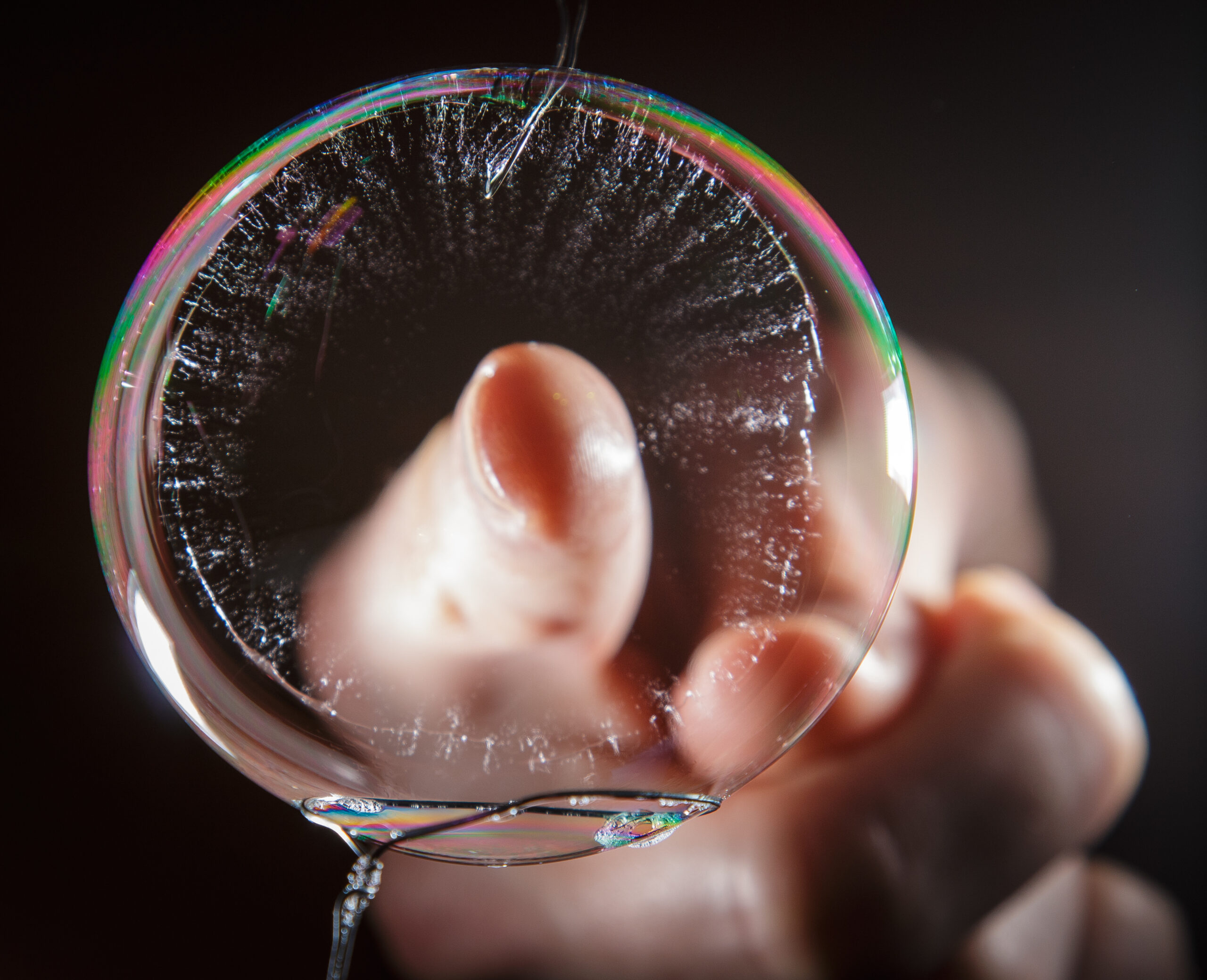
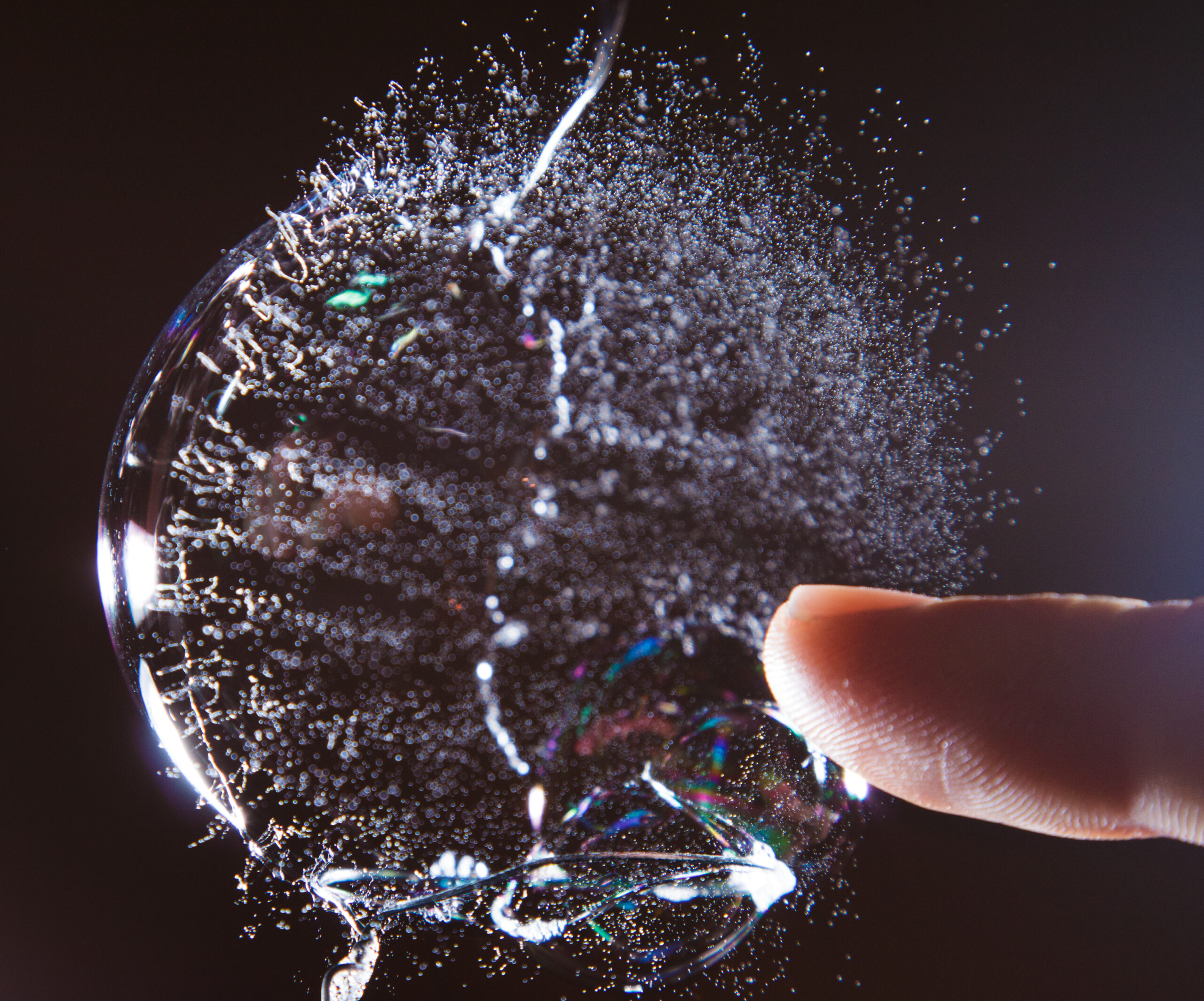
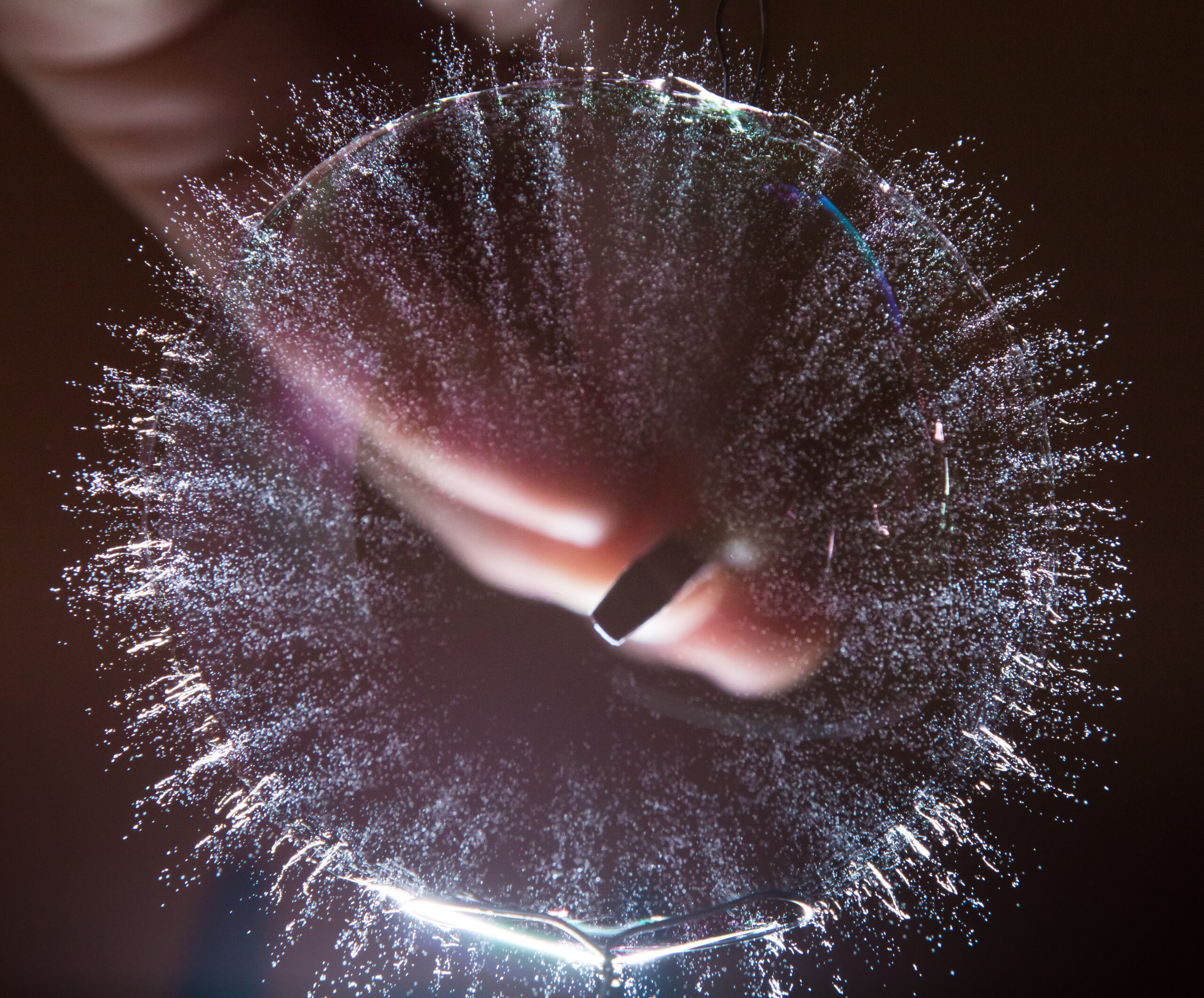
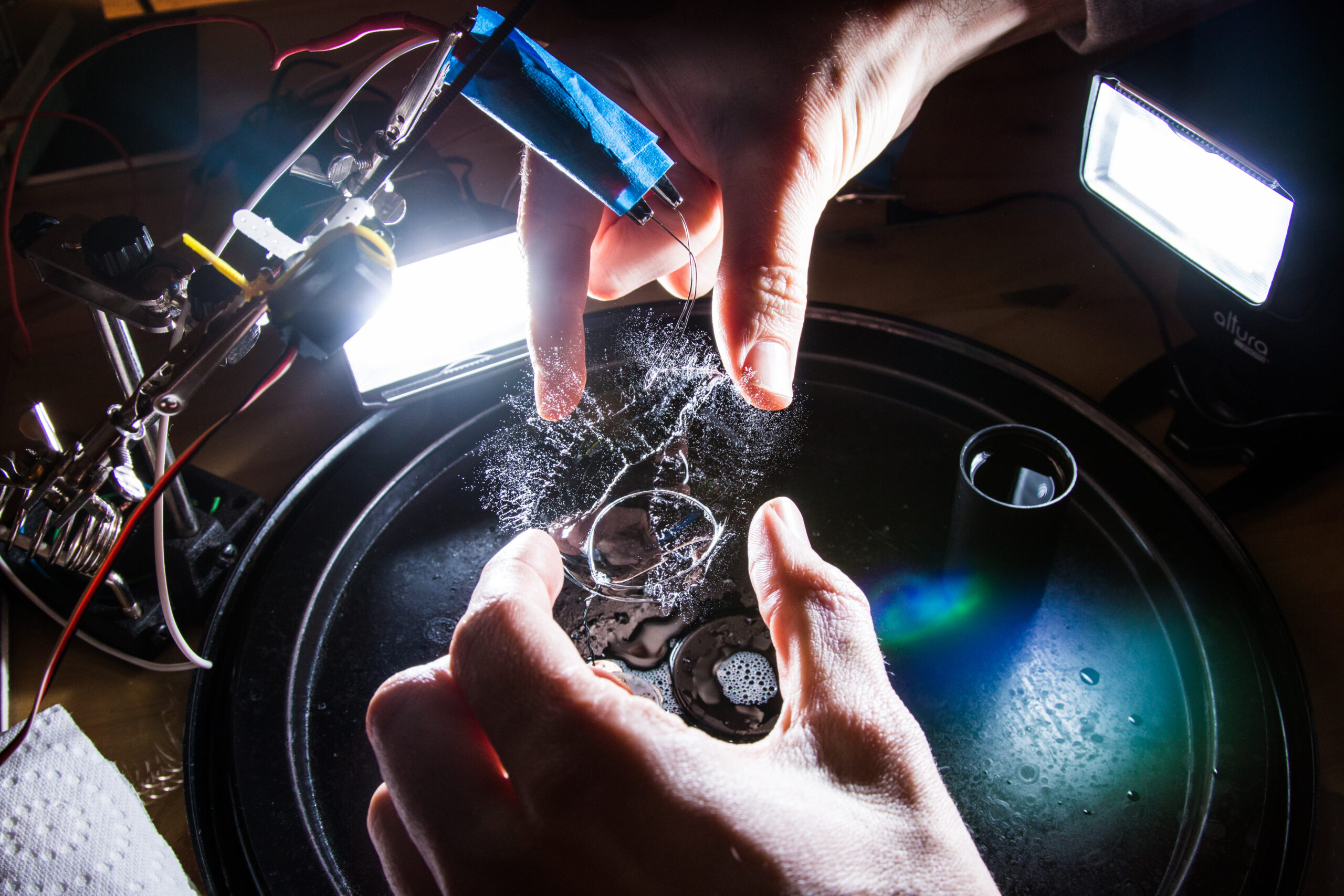
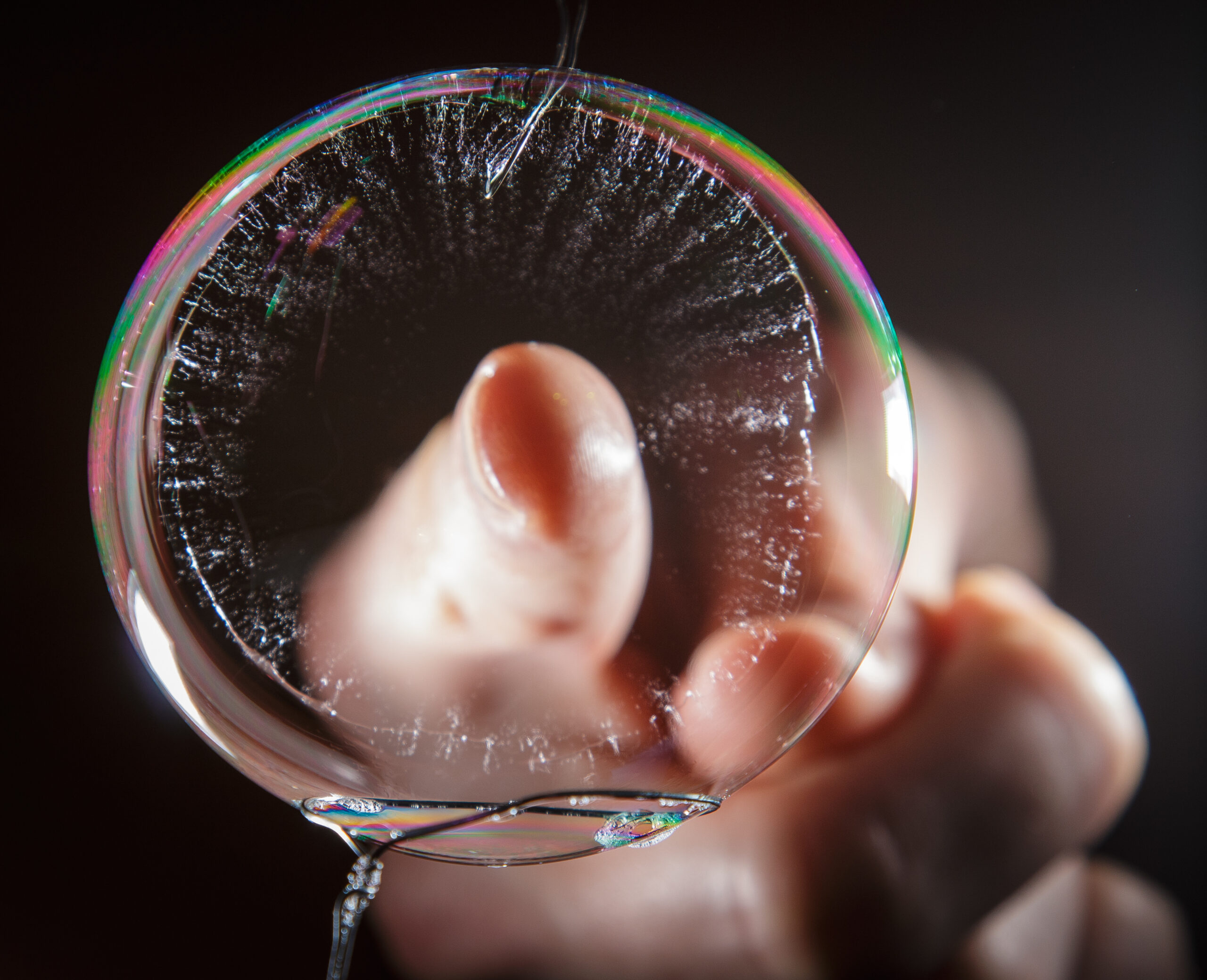
Bubble photography by British photographer Richard Heeks, who has spent years capturing the instant a bubble bursts. See his work via DPReview: “Photographing bubbles, one bubble at a time.”
Sources & Notes
Thin-film interference and the “black film”: standard optics; the colored bands on a vertical film are fringes of equal thickness, distinct from Newton’s rings (the concentric pattern from a curved lens on a flat plate).
Film retraction speed follows the Taylor–Culick relation; typical soap films retract at tens of m/s, and the thinnest films approach ~100 m/s, with elastic films able to exceed the Taylor–Culick limit.
Plateau’s laws (films meet by threes at 120°; edges by fours at the tetrahedral ~109.47°): J. Plateau, 19th c. Largest free-floating soap bubble: Guinness World Records (~96 m³, outdoor record). Long-lived bubbles: research on glycerol films and “gas marbles” (e.g. Roché et al.).
Surface tension ~0.025 N/m and film thicknesses are typical order-of-magnitude values and vary with soap formula, humidity, and age of the film. The closing line is a paraphrased sentiment, not a verified verbatim quotation.
This Article Connects To
A bubble is surface tension solving an optimization problem for free: of every shape that could hold this air, it finds the one with the least surface — a pure trade-off between volume and skin. Its colors are a signal pulled from noise, light waves adding and cancelling to write the film’s exact thickness across its face. And the whole drama plays out at the scale of nanometers, a skin thinner than the very light that lights it up. The same patterns run through physics and the mind.
See all seven on the Core Patterns map →